
Process cooling, heavy dust exhaust, relative humidity controls, and worker thermal safety systems for Chakan & Bhosari factories.
Sizing climate controls for temperature-critical manufacturing workflows.
Manufacturing plants require HVAC systems that serve multiple, simultaneous purposes: maintaining product quality through process climate control, protecting worker health and safety through compliant ventilation, managing equipment heat loads to prevent overheating, and providing comfortable working conditions in offices and quality control areas.
AirSmart has delivered HVAC solutions for a diverse range of manufacturing environments across Pune \u2014 automotive component manufacturers, precision engineering workshops, food and beverage processors, packaging manufacturers, plastic and rubber processors, pharmaceutical manufacturers, and textile producers.
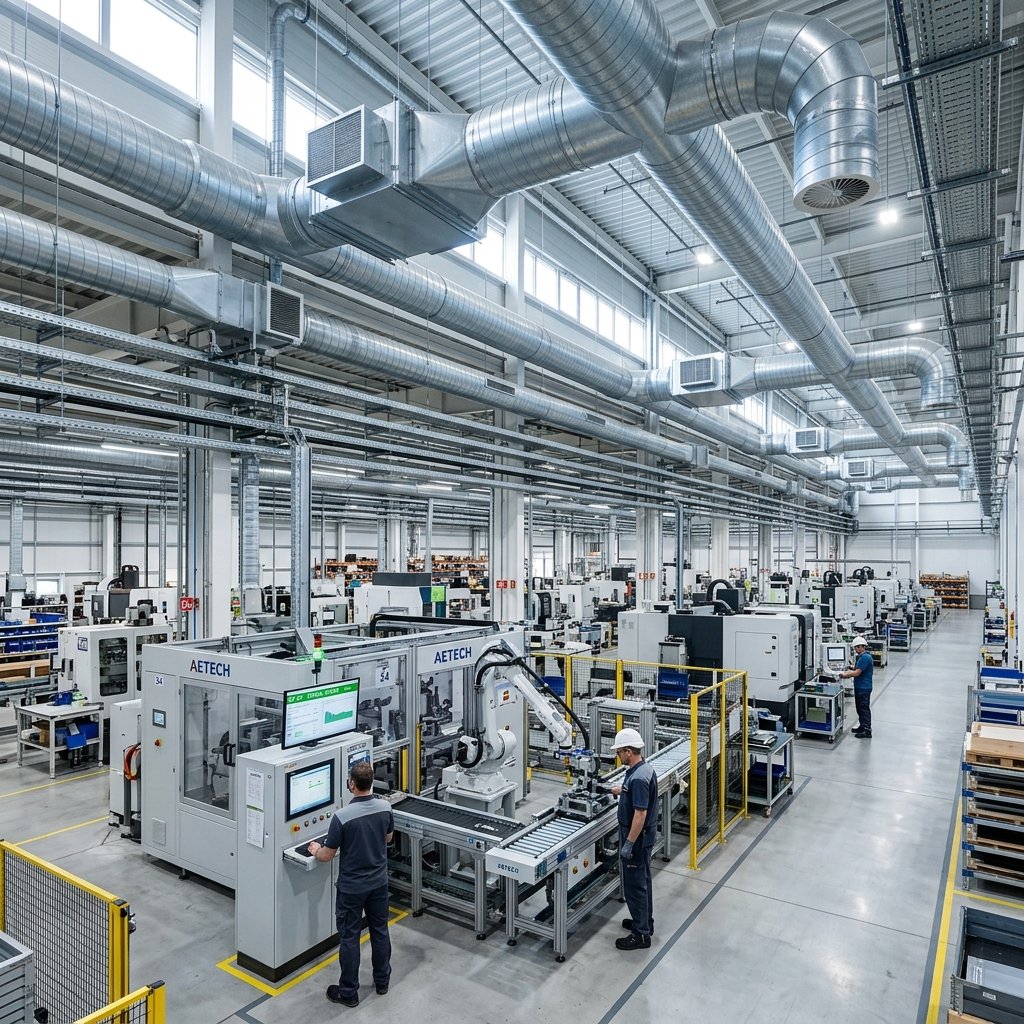
Each manufacturing environment has unique HVAC requirements based on the processes involved, the materials handled, the equipment operating, and the regulatory standards.
Whether you run a plastic molding floor with hydraulic heat loads, or a precision machining lab requiring ±1°C dimensional stability, AirSmart designs compliant setups.
Industrial production floors present demanding thermal, chemical, and particulate issues.
Furnaces, molding machinery, hydraulic presses, and motors release massive heat. We combine local heat hoods with roof exhausters, operator spot cooling, and separate office AC lines to balance temperatures.
Solvent paint shops require tight humidity controls for paint layers; electronics assembly needs ESD-safe zones; precision CNC areas require temperature stability (±1°C) to prevent metal expansion errors.
Welding creates metal oxides; grinding releases heavy dust; chemical baths emit solvent vapors. Proper hood sizing and extraction velocities are required to keep air concentrations below OEL/TLV limits.
Factories Act rules demand reasonable comfort on shopfloors. Heat stress above 28°C causes accidents and slows output. We install industrial evaporative coolers and ridge gravity vents to maintain comfort.
Targeted ventilation and mechanical cooling configurations.
Combination of roof-mounted exhaust blowers, low-level fresh air louvers, HVLS ceiling fans for destratification, and high-capacity industrial evaporative coolers.
Source-capture local exhaust ventilation (LEV) hoods at welding, grinding, or chemical stations. Concealed ducted systems and clean rooms with independent AHUs.
Full VRF or split AC systems for laboratories, quality rooms, and administration offices. positive air pressurization blocks fine industrial dust from entering office zones.
All AirSmart installations satisfy MIDC guidelines and national factory rules:
For moisture-sensitive assembly lines, we configure active dehumidification:
Common questions asked by manufacturing plant directors and safety officers.
Plastic injection moulding generates heat from the machines, hydraulic systems, and the polymer melt process, along with thermal decomposition products from the polymer that require exhaust ventilation. HVAC for a plastic moulding facility typically includes: general dilution ventilation for the moulding floor, local exhaust ventilation at machine nozzle areas where polymer fumes are generated, evaporative cooling or targeted fan cooling for operator workstations, and separate air-conditioned areas for quality control and material handling. AirSmart assesses the specific polymer materials being processed to determine appropriate LEV design for the contaminants involved.
Humidity control in manufacturing plants requires dehumidification equipment \u2014 either refrigerant-based (for process areas requiring low humidity) or desiccant-based (for very low humidity requirements). Controlling infiltration of humid outdoor air through the building envelope and particularly through loading doors is also important, especially during Pune\'s monsoon season. For precision manufacturing processes requiring tight humidity control (\u00b15% RH or better), dedicated air handling units with humidity control capacity are specified.
Welding workshops require exhaust ventilation designed to maintain welding fume concentrations below applicable Occupational Exposure Limits (OELs). For general welding areas, this typically requires dilution ventilation providing 10,000\u201320,000 CFM of exhaust per welding station as a general guideline, or Local Exhaust Ventilation (LEV) hoods positioned within 300mm of the welding arc for source capture at lower overall airflow volumes. LEV is preferred for enclosed areas. AirSmart designs welding ventilation systems based on the specific welding process, electrode types, and floor area.
Proven track record in commercial and industrial HVAC across Pune.
We don't guess. We perform load calculations and audits before quoting.
No sub-contracting. Our own trained technicians handle every installation.
Our engineers will visit your plant, review process emission sources, and provide a compliance and design quote. Free site visit.
Partner with AirSmart for professional air conditioning, ventilation, exhaust systems, installation, repair, and AMC maintenance designed for commercial and industrial spaces across Pune and Maharashtra.