Proper Airflow Is Not Optional — It Is a Health, Safety & Performance Requirement. Compliant Designs in Pune.
We design systems that optimize indoor oxygen levels and extract hazards.
Ventilation and exhaust systems are frequently the most under-specified component of commercial and industrial HVAC projects. Businesses focus on cooling capacity and comfort, but overlook the critical role that proper fresh air supply and exhaust plays in indoor air quality, worker health, regulatory compliance, and even cognitive performance.
Research consistently shows that poor indoor air quality — elevated CO2 levels, insufficient fresh air exchange, accumulation of volatile organic compounds from furniture and building materials — reduces worker cognitive performance by measurable amounts. Studies cited by ASHRAE and the US EPA show that optimizing ventilation in commercial offices produces productivity gains worth 5–10x the cost of the ventilation system itself. In industrial settings, the stakes are even higher — inadequate ventilation is a direct health and safety hazard.
AirSmart designs and installs ventilation and exhaust systems for all types of commercial and industrial environments in Pune. Our systems are properly engineered — with calculated air change rates based on occupancy and activity type, correctly sized fans for the required static pressure, properly designed ducting for uniform air distribution, and compliance with applicable Indian and international ventilation standards.
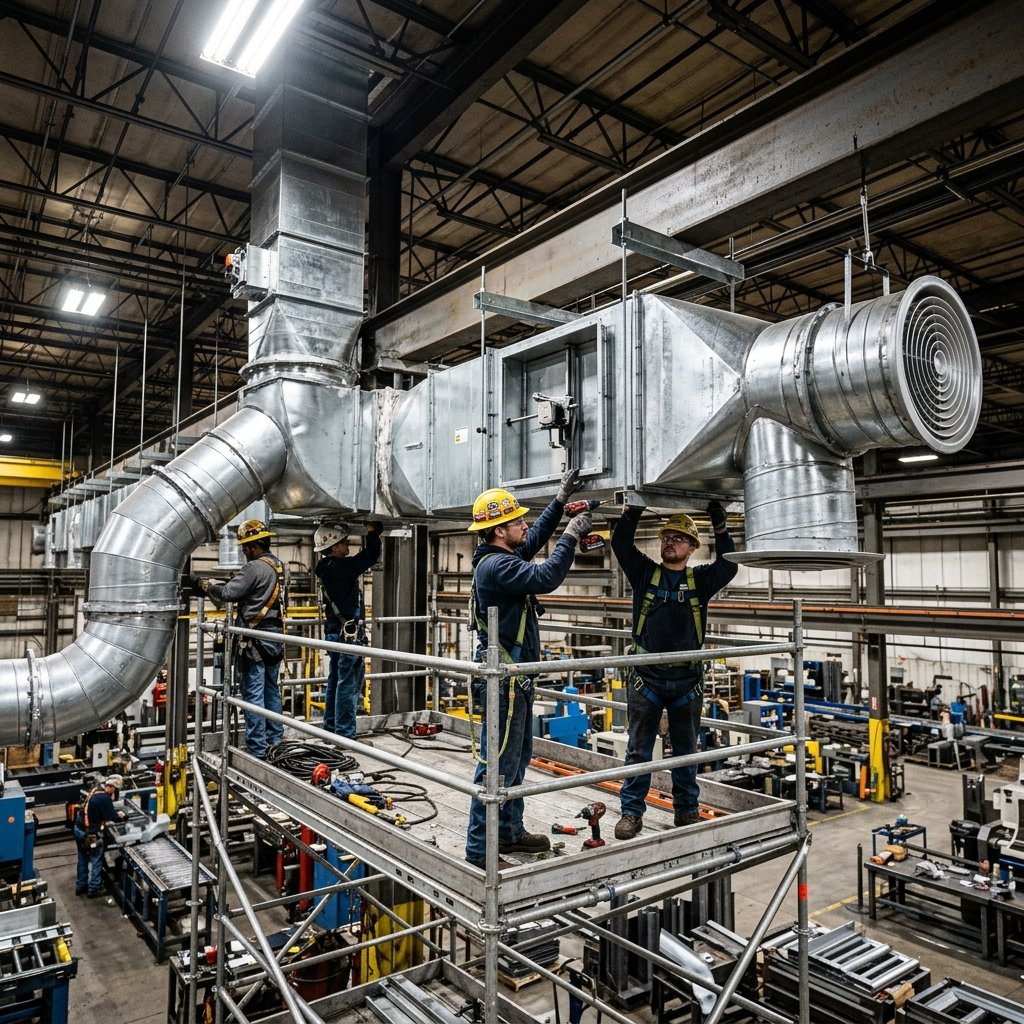
We design exhaust hood configurations and dilution ventilation to meet Section 13 and 14 guidelines of the Indian Factories Act, ensuring factory inspector approvals.
We engineer distinct fresh air supply and contaminated air removal pathways depending on your industry sector.
Dedicated Outdoor Air Systems (DOAS) supply filtered, conditioned fresh air to occupied spaces. Sized to meet ASHRAE 62.1 or equivalent Indian standard minimum requirements. Features demand-controlled ventilation loops using carbon dioxide (CO2) sensors that automatically adjust airflows based on headcount.
ERV systems capture the thermal energy (cooling or heating) in outgoing stale exhaust air and transfer it to the incoming warm outdoor air. In Pune's climate, ERV units reduce the cooling energy penalty imposed by fresh air requirements by 50-70% compared to direct fresh air blowers.
Process-specific Local Exhaust Ventilation (LEV) designed for welding hoods, laser cutter rooms, chemical baths, and factory heat extract sweeps. Sized to maintain workplace chemical/dust concentrations below Occupational Exposure Limits (OEL).
Kitchen exhaust systems for corporate cafeterias and restaurants are designed to extract hot grease-laden vapor. Sized per hood lengths, using heavy-duty grease filters, fire suppression system interfaces, and dedicated makeup air provisions to prevent negative pressures.
AirSmart engineers design, size, and document every industrial ventilation and commercial exhaust layout to strictly comply with the following codes:
Workers operating in forging shops, chemical mixing areas, printing layouts, or welding zones require active ventilation to prevent occupational respiratory illnesses.
We size hoods to maintain the required capture velocities (typically 0.5 to 2.5 m/s depending on gas weight) to prevent hazardous fumes from escaping into employee breathing zones, ensuring workplace health and safety.
Common technical and compliance questions about mechanical ventilation and exhaust designs.
An Energy Recovery Ventilator (ERV) is a mechanical system containing a heat exchanger core. It draws cool stale air out of an air-conditioned building and uses its thermal energy to pre-cool the hot fresh outdoor air being pulled in. This pre-conditioning removes a large portion of the sensible and latent heat load before the air hits your AC coils, saving up to 50-70% in ventilation energy costs.
Section 13 of the Factories Act requires factories to maintain adequate ventilation and fresh air circulation. Section 14 mandates local exhaust systems for dust, gas, or fume generation. AirSmart performs calculations to verify the required air change rates (ACPH) and capture velocities, designing systems that pass factory inspector audits.
Capture velocity is the air speed required at the face of an exhaust hood to pull dust, fumes, or gas away from the source and into the ductwork. If capture velocity is too low, fumes escape into the workshop. AirSmart calculates static pressure drops and specifies fans to maintain proper velocity profiles.
Yes, AirSmart designs and fabricates ductwork (using galvanized sheet steel or pre-insulated panels) based on site dimensions. We execute duct layout modeling to balance static pressure and ensure uniform air distribution.
Proven track record in commercial and industrial HVAC across Pune.
We don't guess. We perform load calculations and audits before quoting.
No sub-contracting. Our own trained technicians handle every installation.
Our engineering team will assess your facility ventilation needs, calculate air change rates, and design a compliant proposal.
Partner with AirSmart for professional air conditioning, ventilation, exhaust systems, installation, repair, and AMC maintenance designed for commercial and industrial spaces across Pune and Maharashtra.